

Mix Your Workouts, Live Longer? New Study Shows Exercise Variety Cuts Death Risk
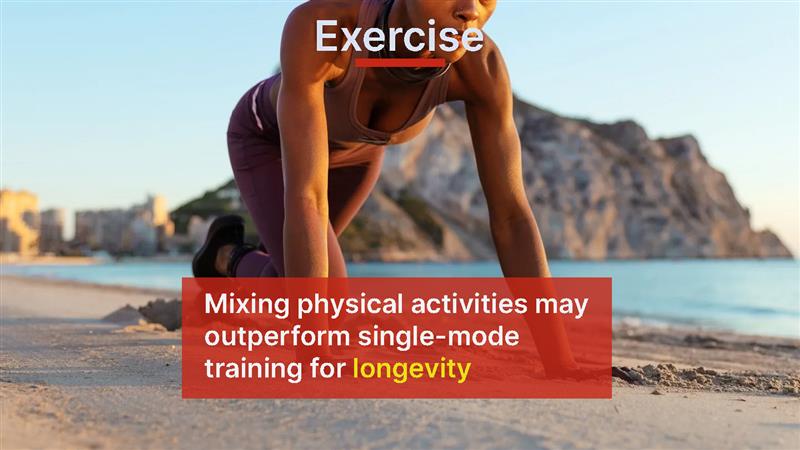
A large BMJ Medicine study finds that doing different types of physical activity, not just more of it, is linked to significantly lower mortality risk. Variety may be a missing piece in longevity.
A major new study published in BMJ Medicine challenges one of the most common assumptions in fitness. It is not just how much you exercise that matters. It is how varied your movement is.
Researchers analyzed data from more than 110,000 participants followed over three decades in two landmark cohorts: the Nurses’ Health Study and the Health Professionals Follow-Up Study. The question was simple but powerful: does doing different types of physical activity improve survival beyond total exercise volume?
The answer is yes, and the effect is striking.
Across more than 2.4 million person-years of follow-up, individuals who engaged in a wider variety of physical activities had significantly lower mortality rates. Those in the highest “exercise variety” group had about 19% lower risk of death from all causes compared with those in the lowest group.
This benefit extended across major causes of death, including cardiovascular disease, cancer, and respiratory conditions.
Not all exercise is equal. And not all exercise works the same
The study confirmed that most individual activities, such as walking, running, resistance training, and racket sports, were associated with lower mortality. However, the magnitude of benefit differed depending on the activity.
Interestingly, swimming did not show a statistically significant mortality reduction in this dataset, a finding that may reflect population differences rather than a true lack of benefit.
More importantly, the researchers found that combining different types of activity provided additive advantages.
Why? Because each type of exercise targets different physiological systems:
- Aerobic exercise improves cardiovascular fitness
- Resistance training builds muscle and metabolic health
- Weight-bearing activities strengthen bones
- Coordinative or mixed sports enhance neuromuscular function
When combined, these adaptations create a broader health buffer.
Variety matters even if you already exercise enough
One of the most important findings is that exercise variety works independently of total activity levels.
Even after adjusting for how much people exercised, those with more diverse routines still lived longer.
This suggests that simply increasing volume is not the only path to better health. Diversifying movement patterns may unlock additional longevity benefits.
The relationship was also non-linear, meaning the biggest gains likely occur when moving from very low variety to moderate variety, rather than endlessly adding new activities.

A paradigm shift in how we prescribe exercise
For decades, public health messaging has focused on duration and intensity. This study suggests a third pillar: diversity.
Instead of prescribing only “150 minutes per week,” future guidelines may need to emphasize movement portfolios. A mix of walking, strength training, and other activities could be more effective than specializing in just one.
This aligns with emerging evidence that the human body thrives on varied mechanical and metabolic stimuli.
Why This Matters for GeneFit Readers
This is exactly where GeneFit’s philosophy becomes clinically powerful.
Most patients focus on a single strategy. For example, only cardio for weight loss or only gym training for muscle. This study shows that approach is incomplete.
From a metabolic reprogramming perspective, variety is not optional. It is essential.
At GeneFit, this translates into three actionable principles:
- Combine aerobic and resistance training in structured programs
- Rotate movement patterns to avoid physiological adaptation plateaus
- Personalize activity “mixes” based on metabolic phenotype and goals
This is not just about fitness. It is about longevity engineering.
The real takeaway: your body does not need more exercise. It needs smarter, more diverse stress signals.
Reference
Han, H., Hu, J., Lee, D. H., Zhang, Y., Giovannucci, E., Stampfer, M. J., Hu, F. B., Hu, Y., & Sun, Q. (2026). Physical activity types, variety, and mortality: Results from two prospective cohort studies. BMJ Medicine, 5(1), e001513. https://doi.org/10.1136/bmjmed-2025-001513
Disclaimer: The information on this website is for educational purposes only and does not constitute medical advice, diagnosis, or treatment. Content is based on publicly available scientific sources and does not replace consultation with a DHA-licensed healthcare professional. No claims are made that this information can prevent, diagnose, or cure any disease. Individual results may vary. GeneFit Clinics assumes no responsibility for any consequences arising from the use of this information.
Ready to unlock your potential?
Your body deserves better than guesswork.
Book a consultation to discover a personalised transformation experience, built on your unique biology and delivered with concierge-level care.